Adhd.kids
The Steady Corner - parent support systems for ADHD family life
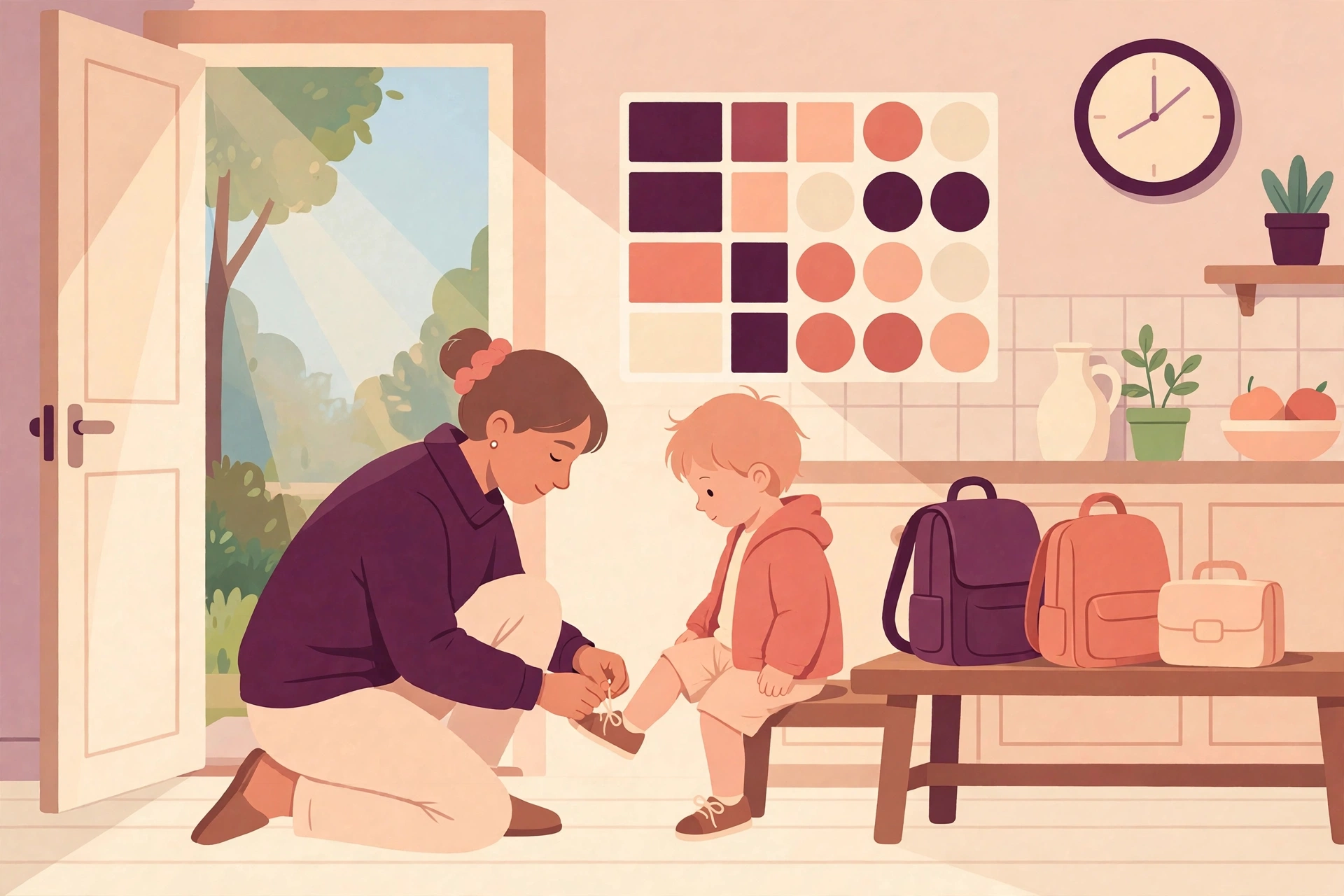
Warm illustration of a family morning in a kitchen: a parent tying a child's shoe by the door, a routine chart on the wall, bags and a lunchbox ready
A calmer morning starts the night before: bags ready, chart on the wall, shoes by the door.

Independent parent support publication

Calmer days, built as systems

The Steady Corner is an independent publication for parents and carers of children with ADHD. It covers the practical layer of family life: morning and bedtime routines, homework systems, school communication, organisation, timers, transitions and the paper tools that hold them together. Warm, concrete and shame-free, for the parent running the day.

One line first, because it shapes everything here: this is not a medical site. Nothing on Adhd.kids diagnoses, assesses or treats any child, and nothing here replaces the professionals who know yours. What it does is the organisational work around the edges of family life, the part parents are left to invent alone at 7am. Start with morning routines, or pick a corner below. Every guide opens with a routine card: the situation it is for, the system it builds, what you need and the first step.

Walk the corners

Corner 01 - Foundations corner Executive function at home What executive function means at the kitchen table rather than in a textbook: working memory, time, starting, stopping and shifting, explained in plain words for parents, with the home systems that quietly support each one. (12 guides) Corner 02 - Morning corner Morning routines The hardest hour of the family day, rebuilt as a system: the night-before launch pad, visual charts that get used, timers, stations by the door, and a calm handover at the school gate. (12 guides) Corner 03 - Bedtime corner Evening and bedtime routines The wind-down is a system too: the landing strip when everyone gets home, the order of the evening, the last hour of the day, and a bedtime sequence that ends the day kindly instead of loudly. (12 guides) Corner 04 - Homework corner Homework systems Homework stops being an evening battle when it becomes a place, a start ritual, a chunking habit and a timer: the full system, from the first five minutes to the Friday folder reset. (12 guides) Corner 05 - School corner Talking to school Calm, written, and in good time: how to open the first conversation with a new teacher, keep a simple school log, write emails that get a calm reply, and walk into meetings prepared. (12 guides) Corner 06 - US plans corner School plans in the US: Section 504 and IEPs United States edition, explainer level only: what Section 504 plans and IEPs are, how the school evaluation process generally works, and how families prepare, in plain language. General information about public systems, never advice about an individual child's case. (12 guides) Corner 07 - UK support corner School support in the UK: EHCP and SEND United Kingdom edition, explainer level only: SEND support in school, the graduated approach, EHC needs assessments and annual reviews in plain language. General information about public systems, never advice about an individual child's case. (12 guides) Corner 08 - Tidy corner An organised home Organisation that works with a child's brain rather than against it: one home for every school thing, visible places, photo labels, a backpack reset, and a weekly tidy the timer runs instead of a parent. (12 guides) Corner 09 - Time corner Time and timers Time is invisible until a tool makes it visible: choosing a timer a child accepts, time checks instead of warnings, countdown calendars, and practising the question every plan depends on - how long will it take? (12 guides) Corner 10 - Transitions corner Transitions and warnings Changing activity is the flashpoint of the family day. Warnings that land, landing phrases, countdowns, comfort anchors and a Plan B script make the switches smaller, earlier and calmer. (12 guides) Corner 11 - Calm corner Emotional weather at home Feelings run hot in every family; the parent side of the weather is the part this corner works on: pausing, lowering the temperature, repairing afterwards, and one calm script every adult in the house shares. Non-clinical, household level throughout. (12 guides) Corner 12 - Siblings corner Siblings and family fairness When one child needs more time, more patience and more systems, fairness becomes the family question. This corner works on the answers: one-to-one time, sibling meetings, protected space, and explaining difference in plain words. (12 guides) Corner 13 - Screens corner Screens and gaming agreements Screens are where routines go to be tested. This corner builds agreements instead of battles: written family rules, visible timers, an end-of-game system, charging stations, and a monthly review that keeps the peace. (12 guides) Corner 14 - Chores corner Chores and pocket money Jobs around the house, taught as systems rather than nagging: a chore board that does the asking, first chores matched to the child, micro-chores, and pocket money with a simple, steady shape. (12 guides) Corner 15 - Travel corner Holidays and travel New places run on new rules, which is exactly what a routine-loving child finds hardest. Preparation, rehearsal, a base camp in the new room, kept fragments of routine, and a gentle re-entry day home. (12 guides) Corner 16 - Clubs corner Clubs, sport and activities Choosing activities a child will stay with, preparing for the first session, talking to coaches, kit-bag systems, and the quitting conversation handled without shame on either side. (12 guides) Corner 17 - Teens corner Teens and growing independence The handover years: handing over the morning, the homework and eventually the paperwork itself, in stages a teenager can succeed at, with minimum standards agreed rather than imposed. (12 guides) Corner 18 - Parents corner Parent stamina The system runs on a person, and the person needs a system too: ten-minute resets, asking for help, sharing the hard hours, batching the paperwork, and noticing what is already working. (12 guides) Corner 19 - Notebook corner Questions to ask professionals This site does not answer clinical or legal questions; it helps you ask better ones. The one-page brief, the notebook habit, questions for reviews and meetings, and everything in writing afterwards. (12 guides) Corner 20 - Printables corner Printables and checklists The paper tools that carry the systems: morning and bedtime checklists children can tick, a backpack checklist for the front door, planner pages, handover sheets, and how to design your own in ten minutes. (12 guides)

How the corner runs

  1. See the moment
    Every hard moment has a shape: a time of day, a switch, a step that is too big. The guides start by naming the moment precisely.
  2. Shrink the step
    A routine that fails is usually one step too large. Split it, practise the small version, and let success repeat.
  3. Make it visible
    Charts, timers, labels and checklists carry the remembering, so a parent does not have to be the memory for the whole house.
  4. Practise calmly
    New systems are rehearsed at easy times of day, never launched in the middle of the hardest one.
  5. Review monthly
    Children grow and terms change. A short monthly review keeps what works and quietly retires what does not.

How this desk works

Warm illustration of a kitchen table with a paper weekly planner, pencils, a visual timer and a mug, in soft evening light

Three rules. First, systems over willpower: a routine that depends on a child remembering, or a parent nagging, is a routine designed to fail, so every guide moves the remembering into the environment - a chart, a station, a timer, a checklist on the door. Second, support over shame: children are never the problem on this site, and neither are their parents; the unit of work is the routine, and routines can be redesigned without anyone being blamed. Third, the scope stays where it belongs: facts come from the public guidance of health services, education authorities and parent organisations listed on the sources page, school content is explainer level and labelled by country, and questions that belong to professionals are written as questions to ask them - which is why one whole corner is a parent's notebook for exactly that.